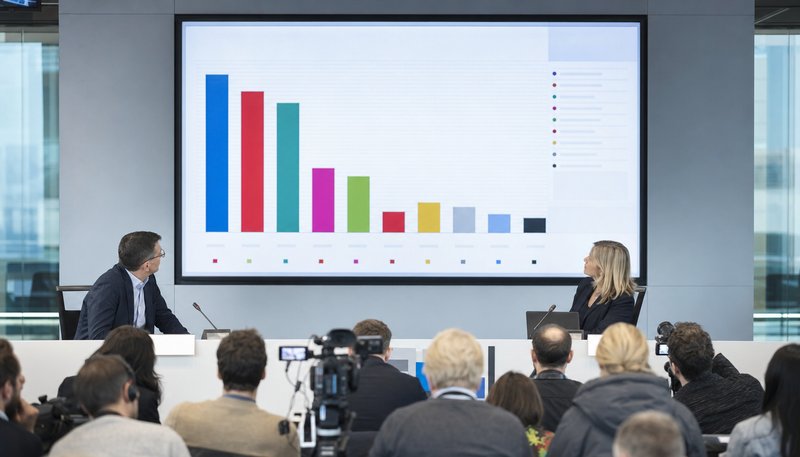
How EU Election Polling Works
EU election polling operates at two levels simultaneously. At the national level, polling firms survey voters in each member state about their intended vote in EP elections, typically asking respondents which national party they would support. At the European level, analysts then map these national party preferences to their corresponding European political group — the EPP, S&D, Renew Europe, Greens–EFA, ECR, Patriots and the Left.
This mapping is complicated by parties that sit outside the major European families, national parties that have changed group affiliation, and new entrants without a clear group home. The post-election group formation process can itself change the seat distribution significantly, as MEPs elected under one party banner join a different group than expected.
The EPP's Structural Advantage
The European People's Party has been the largest group in the European Parliament since 1999. This longevity reflects a structural advantage: the EPP encompasses the dominant centre-right parties in most large member states, including Germany (CDU/CSU), France (until the 2022 emergence of Macron's Renaissance), Poland (PO), Spain (PP), Italy (Forza Italia) and most Central European governing parties. Even when individual EPP member parties lose national elections, the group's breadth across member states provides ballast.
In the run-up to EU elections, EPP polling leads typically hold through the campaign. The party's incumbent advantage — EPP has supplied the Commission President in most terms since 2004 — generates a gravity that keeps affiliated national parties in the fold even under pressure from insurgent competitors. Understanding why the EPP leads in pre-election polling requires understanding this structural map of European Christian Democracy and centre-right politics.
Reading EP Seat Projection Models
Seat projection models for the European Parliament translate national polling averages into seat counts for each group. The most robust models incorporate several factors beyond simple poll aggregation: historical turnout differentials between member states (Northern European turnout tends to be higher than Southern or Eastern European); the seat-population ratio for each country (which favours smaller member states on a per-voter basis); and uncertainty around group affiliation for parties in flux.
A common error in reading projection models is treating the point estimate — "EPP: 185 seats" — as more precise than it is. EU election seat projections carry inherent uncertainty from aggregating polls across 27 different polling environments, each with their own house effects, sampling approaches and question wording. The credible interval around any projection typically spans 15–25 seats in each direction for major groups.
Campaign Dynamics and Late Shifts
EU elections are unusual in that campaign dynamics often have less impact than in national elections. Voter attention to European Parliament campaigns is lower — turnout itself is a significant variable — and the trans-European nature of the campaign means that events in one country rarely dominate the news across all 27 member states simultaneously. Late shifts in polling in the final month tend to be smaller in EU elections than in comparable national elections.
That said, the final weeks of an EU election campaign can still produce meaningful movements, particularly in member states where EU politics is highly salient. The 2024 campaign saw late movement in France — where President Macron's decision to dissolve the National Assembly immediately after election night created an outsized news environment — and in Germany, where the outcome of the EU election itself reshaped coalition dynamics at national level. See also the early prediction analysis for comparison with how projections evolved across the campaign.
The EPP–S&D–Renew Coalition and Its Limits
Since 2019, the working majority in the European Parliament has rested on the three-group coalition of EPP, S&D and Renew Europe. This coalition controls enough seats to pass legislation, elect the Commission President, and distribute committee chairs — but it is not automatic. Each major legislative vote requires negotiation, and defections from any of the three groups can require reaching for votes from the Greens or ECR depending on the issue.
Polling data on individual group trajectories therefore matters not just for the headline seat count but for the coalition arithmetic. A weakening Renew Europe — as occurred in the 2024 cycle — reduces the governing coalition's majority and may require more systematic engagement with either the Greens or the right. Tracking these shifts requires following not just the EPP's lead but the relative strength of all three coalition partners across member states.
Frequently Asked Questions
How are EU election polls conducted?
EU election polls are conducted by national polling firms in each member state, typically asking voters which party they would support in a European Parliament election. The Eurobarometer survey, commissioned by the European Commission, also tracks EU election intentions periodically. These national polls are then aggregated and mapped to European political groups to produce seat projections.
Why does the EPP consistently lead in European Parliament polls?
The EPP's consistent polling lead reflects its breadth across member states. It encompasses the dominant centre-right parties in most large EU countries — Germany, Spain, Poland, Italy and others — providing a structural seat base that persists even when individual member parties face domestic difficulties. The EPP has been the largest group in the EP since 1999.
What is the difference between an EU election poll and a seat projection?
An EU election poll measures voting intentions in a single country or a sample of countries. A seat projection translates those voting intentions into an estimate of how many seats each European political group would win across all 27 member states, accounting for each country's seat allocation, the proportional electoral system used, and the likely group affiliation of elected MEPs.
How many seats does the EPP have in the European Parliament?
Following the June 2024 elections, the EPP holds approximately 188 seats in the 720-seat European Parliament — the largest of any group. This represents an increase from 176 seats in the 2019–2024 term, confirming the EPP's position as the dominant force in the Parliament.
How do late campaign shifts affect EU election results?
Late campaign shifts have historically had smaller effects in EU elections than in national elections, partly because voter attention to the campaign is lower. However, significant national-level events — dissolution of a parliament, a major political scandal, or a surge in a particular issue — can produce late movement in specific member states, which can shift the overall seat count for European groups.
What is the EPP's relationship with other European Parliament groups?
The EPP governs the European Parliament through a working coalition with the S&D and Renew Europe groups. This coalition controls a majority of seats and determines the distribution of committee chairmanships, Vice-Presidencies and the nomination of the Parliament President. The EPP also interacts selectively with the ECR and Greens on specific legislative files where the three-group majority coalition cannot agree.