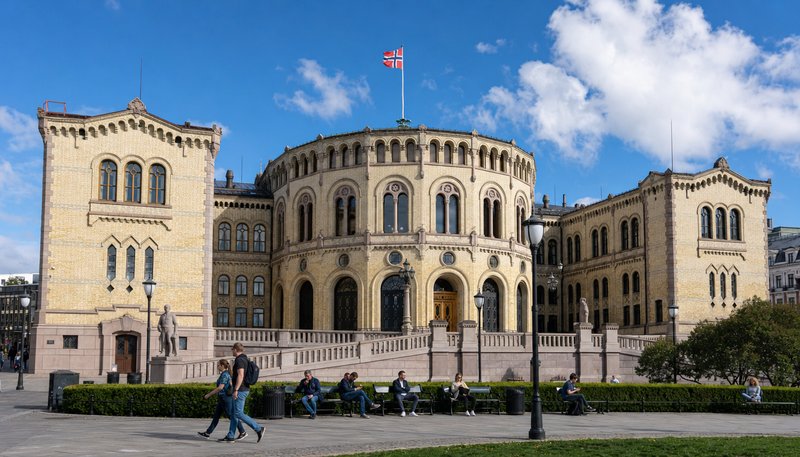
The Norwegian Electoral System
Norway elects its 169-seat parliament — the Storting — every four years using a proportional list system. The country is divided into 19 constituencies corresponding to its counties, with seats allocated using the modified Saint-Laguë method. A national threshold of 4% applies for a party to receive any of the 19 levelling seats that correct for constituency-level disproportionality; parties below this threshold can still win constituency seats if their local vote is strong enough.
Elections are held in September, with a fixed schedule that does not allow early dissolution — a constitutional feature that distinguishes Norway from most parliamentary systems and makes election dates predictable years in advance. The September 2025 elections were the most recent Storting elections, following the cycle established since 1945.
The Norwegian Party System
Norwegian politics is structured around a left–right bloc system that has stabilised since the late 1960s. The centre-left bloc is anchored by the Labour Party (Arbeiderpartiet), while the centre-right bloc is led by the Conservatives (Høyre). Between and around these two poles sit several parties that hold considerable influence:
- Labour (Ap) — Social democratic; the historically dominant party, typically receiving 20–30% of the vote.
- Conservatives (H) — Centre-right; the main opposition to Labour and the leading party of the right-wing coalition.
- Progress Party (FrP) — Right-wing populist; the most Eurosceptic major party, typically finishing third or fourth.
- Centre Party (Sp) — Agrarian, centrist; strong in rural constituencies, sometimes holding the balance of power.
- Socialist Left (SV) — Left of Labour on welfare and environment; often a coalition partner.
- Liberals (V) and Christian Democrats (KrF) — Centrist parties with distinct identities; often crucial for majority-building.
- Greens (MDG) — Environmental party; below the threshold in some elections but influential on climate policy.
How Norwegian Election Forecasting Works
Norwegian polling is conducted by several firms — Kantar, Respons Analyse, Norstat and Ipsos among them — and published regularly throughout the electoral cycle. Poll aggregation models, similar to those used in European Parliament election forecasting, have become standard tools for Norwegian election analysts.
The core challenge in Norwegian forecasting is translating national poll shares into seat projections, accounting for the 4% threshold effect, constituency variation and the levelling seat mechanism. A party polling at 3.8% nationally may be on course to win no levelling seats while still picking up two or three constituency seats — a distinction that polling headlines rarely capture. Seat models that incorporate historical constituency-level data produce substantially more accurate forecasts than simple proportional projections from national polls.
Key Themes in Norwegian Election Cycles
Several recurring themes shape Norwegian electoral outcomes. Energy policy is particularly salient: as a major oil and gas producer, Norway faces ongoing debates about the pace of North Sea development, oil fund investment rules and the transition to renewable energy — debates that intersect directly with EU energy policy given Norway's EEA status. Immigration has been a persistent issue since the 2015–16 migration crisis, while housing costs and regional development recur as concerns in Storting elections.
The 4% threshold also generates strategic voting patterns: voters who support a small party below the threshold face an incentive to vote for a slightly larger party likely to clear it, to ensure their vote contributes to the bloc they prefer. Understanding these threshold dynamics is essential for interpreting Norwegian polling data accurately.
Norway and European Integration
Although Norway rejected EU membership in referendums in 1972 and 1994, it maintains a deep integration with the EU through the EEA Agreement and the Schengen Area. Norwegian governments — regardless of their political stripe — must implement EU single market legislation in areas including product standards, financial services, labour mobility and environmental regulation. This arrangement is sometimes called "fax democracy" by critics who argue Norway has obligations without representation in the institutions that make the rules it must follow.
The Norwegian model of European integration is relevant to debates elsewhere, particularly in the United Kingdom following Brexit. Understanding how Norwegian elections affect the country's relationship with European institutions requires following not just electoral results but the ongoing negotiation of Norway's EEA obligations.
Frequently Asked Questions
When is the next Norwegian election?
Norwegian Storting elections are held every four years in September. The most recent election took place in September 2025. The next scheduled election will be in September 2029, unless there is a constitutional amendment — early dissolution is not possible under Norway's constitution.
Is Norway in the European Union?
No. Norway is not an EU member state, having rejected membership in referendums in 1972 and 1994. However, Norway is a member of the European Economic Area (EEA) and the Schengen Area, which means it participates in the EU single market and implements most EU single market legislation without voting rights in EU institutions.
What is the 4% threshold in Norwegian elections?
Parties must receive at least 4% of the national vote to be entitled to any of the 19 levelling seats that are distributed to correct for disproportionality in constituency results. Parties below the threshold can still win direct constituency seats if they have strong enough local support, but they receive no levelling seats.
How many seats are in the Norwegian parliament?
The Norwegian Storting has 169 seats. Of these, 150 are constituency seats allocated across Norway's 19 electoral districts, and 19 are levelling seats distributed nationally to improve proportionality between vote shares and seat totals.
What is Norway's relationship with EU legislation?
Through the EEA Agreement, Norway is obliged to incorporate EU single market legislation into Norwegian law. This covers the four freedoms (goods, services, capital and persons), as well as areas such as competition policy, environmental standards and financial regulation. Norway does not have voting rights in EU legislative bodies.
Which party won the 2025 Norwegian elections?
The 2025 Norwegian Storting elections resulted in a change of government, with the centre-right bloc led by the Conservatives (Høyre) winning a parliamentary majority. The incumbent Labour-led coalition lost its majority, ending a four-year term. Final seat allocations were determined by the modified Saint-Laguë method across all 19 constituencies plus levelling seats.