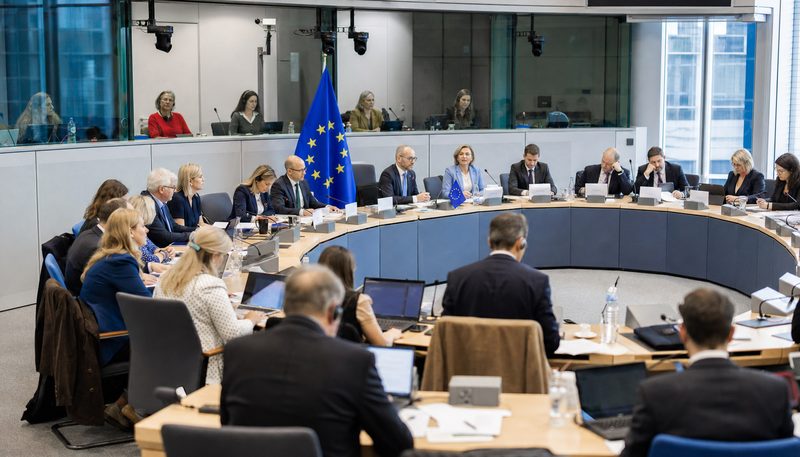
Understanding the committees is the quickest way to understand how Parliament really decides. This guide explains how they are built, who drafts the texts and why some reports carry legal weight while others are statements of political intent.
A Parliament Built Around Committees
Parliament currently has 22 standing committees and two subcommittees. The number rose in December 2024, when MEPs voted to upgrade the subcommittees on Security and Defence (SEDE) and on Public Health (SANT) into full committees, a sign of how the political agenda had shifted since the pandemic and the war in Ukraine.
Each committee covers a policy area that broadly mirrors the portfolios of the European Commission: budgets, foreign affairs, environment, economic and monetary affairs, civil liberties and so on. Seats on each committee are shared out between the political groups in proportion to their size in the chamber, so the balance of power in a committee usually reflects the balance in plenary.
Chairs and vice-chairs are distributed in the same proportional way. After every election the groups negotiate who gets which chair, and the larger groups get first pick. Those negotiations are one of the most closely watched parts of the post-election reshuffle, as our piece on tracking MEP seat allocation explains in more detail.
IMCO: The Single Market Committee
The Committee on the Internal Market and Consumer Protection, known as IMCO, is a good example of how much influence a committee can have. Its remit covers the free movement of goods and services, the rules that let companies sell across borders and the protections consumers get when they buy something in another member state.
In recent terms IMCO has been at the centre of the EU's digital agenda, taking a leading role on the Digital Services Act and the Digital Markets Act. It has also handled product safety, the common charger rules for phones and many files on consumer rights. Because the single market touches almost every sector, IMCO often finds itself negotiating with other committees over who owns a file, and the answer can shape the final text as much as any amendment.
Rapporteurs and Shadow Rapporteurs
Every file a committee handles is given to a rapporteur, the MEP responsible for drafting Parliament's position. The groups bid for reports using a points system, so a group that spends its points on one high-profile file has fewer left for the next. Choosing which files to fight for is a strategic decision for group coordinators.
The other groups each appoint a shadow rapporteur to follow the file for them. The rapporteur drafts a report, the committee members table amendments and the rapporteur then meets the shadows to merge them into compromise amendments. Most of the real negotiation happens in those shadow meetings, which are closed to the public. When the committee finally votes, the outcome is often a formality because the compromises have already been agreed.
For legislative files the committee vote is also the moment Parliament gives its negotiators a mandate. Under the ordinary legislative procedure the rapporteur and shadows then sit down with the Council and the Commission in trilogues, informal talks that produce the final compromise both co-legislators vote on.
Own-Initiative Reports
Not every report answers a Commission proposal. Committees can also draw up own-initiative reports on subjects they think deserve attention. These reports need the authorisation of Parliament's Conference of Presidents, which keeps their number under control, and once adopted they are not binding on anyone.
That does not make them unimportant. An own-initiative report records where a majority of MEPs stands on a question before any law exists, and the Commission often cites them when it plans new initiatives. They can also do the opposite and signal that Parliament does not want EU legislation in a field, leaving the matter to national governments. Several IMCO own-initiative reports from the late 2000s did exactly that, setting out positions on sectors where member states wanted to keep control.
From Committee to Plenary
Once a committee adopts a report, it goes to the plenary agenda. Groups can still table amendments at this stage, but a text that passed committee with a broad majority rarely changes much. The plenary vote is where the result becomes official and where MEPs who sit on other committees take a position on the file.
The size of the committee majority is a good predictor of what happens next. A report adopted with support from the main centre groups will usually pass comfortably, while one that split the committee can be rewritten or even rejected in Strasbourg. Watching committee votes is therefore one of the most reliable ways to anticipate how Parliament will decide, in the same way that polling helps anticipate an election.
Frequently Asked Questions
How many committees does the European Parliament have?
Since the December 2024 decision to upgrade SEDE and SANT, Parliament has 22 standing committees and two subcommittees.
What does a rapporteur do?
The rapporteur drafts Parliament's position on a file, negotiates compromises with the shadow rapporteurs from other groups and, on legislative files, leads Parliament's team in talks with the Council.
Are own-initiative reports binding?
No. They express Parliament's political position and need the approval of the Conference of Presidents before a committee can draft one, but they create no legal obligations.
What does IMCO stand for?
IMCO is the Committee on the Internal Market and Consumer Protection, which covers the single market, consumer rights and much of the EU's digital legislation.